North Island Seychelles - What the Island Is and How Access Works
Aug 13, 2026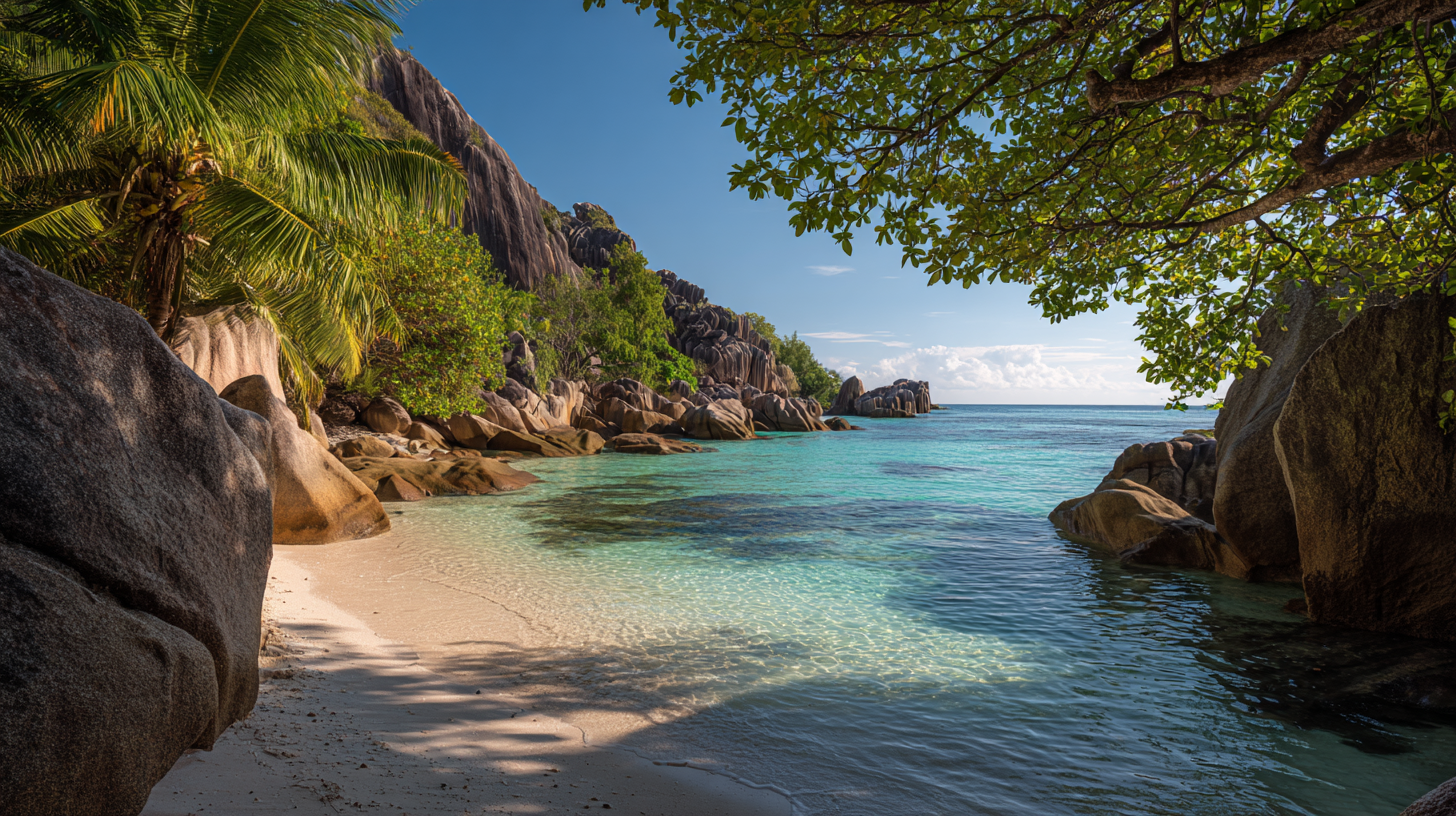
North Island is a private granite island in the Inner Islands of the Seychelles, lying northwest of Mahé and beside Silhouette. The island is closed: there is no public landing, no jetty and no airstrip, which puts it in a small minority of Seychelles islands that a yacht charter cannot include as a stop. Two things made the name widely known, the royal honeymoon of 2011 and a restoration program that began decades before the resort. This page covers what the island is geologically, its history, the restoration work and what it produced, how access is structured, when conditions are best, and how North Island sits among the other private islands of the archipelago.
What Is North Island
North Island is a small granite island in the Inner Islands of the Seychelles, rising from four beaches to a forested interior and a summit at Grand Paloss.
The island is closed to visitors. Its entire surface is held by a single resort, there is no settlement, road or path outside that property, and the only arrival point is a helipad.
|
Parameter |
Detail |
|
Island group |
Inner Islands, granitic Seychelles |
|
Island type |
Granite |
|
Sub-group |
Silhouette group |
|
Size |
Small, around two square kilometers |
|
Terrain |
Hilly and forested, with granite headlands |
|
Highest point |
Grand Paloss |
|
Beaches |
Four, facing four different directions |
|
Nearest island |
Silhouette |
|
Public access |
None |
|
Yacht charter access |
No landing; pass offshore only |
|
Conservation |
Privately managed restoration program since the 1980s |
The island has four beaches, one on each aspect, which is unusual on a landmass this small. East Beach faces the sunrise and carries the resort buildings. West Beach, also called Grande Anse, faces the sunset and takes the most swell. Honeymoon Beach and Petit Anse are smaller pockets between granite headlands.
North Island belongs to the granite half of the Seychelles rather than the coral half, and the difference is structural. The Inner Islands are exposed remnants of a continental fragment left behind when Madagascar and India separated, which is why they carry granite, soil, hills and forest. Coral islands in the Outer Islands are flat sand cays built on reef.
That geology produces the landscape here: boulder headlands separating the beaches, a forested interior with real elevation, and a summit view across to Silhouette and, in clear weather, toward Mahé and Praslin. No atoll in the Seychelles offers a viewpoint at any height.
Why North Island Is Well Known
North Island's recognition rests on three unconnected lines: the royal honeymoon of 2011, an appearance in film, and a restoration program that made the island a reference case in Indian Ocean conservation.
In May 2011 the Duke and Duchess of Cambridge spent their honeymoon on the island. The coverage that followed put the name in front of an audience with no connection to the Seychelles, and most search interest in North Island still traces back to that event.
The island stood in for Tracy Island in the 2004 live-action adaptation of Thunderbirds, which gave it a second line of recognition among people who never associated it with the Seychelles at all.
The restoration program is the third reason and the one with the longest reach. Work began well before the island was bought for tourism, and North Island is now cited as an example of what full ecological rehabilitation of a small tropical island involves.
History of North Island
North Island passed through four periods: the first recorded European landing in the Seychelles in 1609, plantation agriculture through the nineteenth and twentieth centuries, ecological collapse after the plantation closed, and restoration from the 1980s onward.
In 1609 an expedition aboard an English East India Company vessel landed here. This was the first recorded landing anywhere in the Seychelles archipelago, and the crew reported a large population of giant land tortoises on the island.
For roughly a century and a half the island was held by a planter family from Réunion. The plantation grew fruit and spices, and the island also produced guano, fish oil and copra. Plantation agriculture replaced most of the native forest with coconut palm.
After the plantation was sold in the 1970s the island fell out of use. Introduced animals bred unchecked, invasive weeds spread across the cleared ground, and what remained of the endemic vegetation continued to retreat.
In the early 1980s the island passed to a new owner who set out to return it to its pre-settlement condition. Turtle nest monitoring began at that point and has run continuously since, which gives the island an unusually long conservation record for a private property.
The island was bought by an ecotourism operator in the late 1990s and a resort opened in the following decade. The commercial operating arrangement has changed more than once since, so anyone relying on operator information should confirm the current position rather than published material.
The Noah's Ark Restoration Program
The restoration of North Island followed a fixed sequence: remove the introduced animals and plants, rebuild the native vegetation, then return the species that had been lost. The order is not arbitrary, because reintroducing a bird to an island that still holds rats and cats simply feeds them.
Removal came first and covered four categories, each blocking recovery differently. Rats and cats took ground-nesting birds and their eggs. Pigs and cattle broke up the soil and prevented seedlings from establishing. Indian mynah birds displaced endemic species from nesting sites. Coconut palm, casuarina and lantana had colonized the cleared plantation ground and suppressed native regrowth.
Replanting followed. Takamaka, badamier and the coco-de-mer palm were reintroduced alongside other endemic species, rebuilding the forest structure that ground-nesting birds and tortoises depend on.
The reintroductions came last, once the island could support them. Aldabra giant tortoises now range freely across the island rather than living in an enclosure. Seychelles white-eyes, among the rarest endemic birds in the country, were relocated here and the population has since established itself. North Island records among the highest densities of nesting green turtles in the Inner Islands.
The program is the reason North Island functions as a nature reserve that happens to carry a resort, rather than the reverse. That distinction matters when comparing it with private islands where conservation arrived after the hotel.
Wildlife and Marine Environment
North Island holds a restored terrestrial ecosystem and a granite marine environment, managed as one. Its value as a wildlife site comes from the combination rather than from either alone.
On land, the flagship species are the Aldabra giant tortoise and the Seychelles white-eye. Tortoises move freely through the forest and along the tracks. The white-eye population, established from a small relocated group, is one of the few self-sustaining populations of the species anywhere.
The beaches are green turtle nesting habitat, with nesting concentrated in the sheltered pockets between the granite headlands. Hawksbill turtles also use the island. Monitoring has run without interruption since the 1980s.
Underwater, the granite Inner Islands produce a different structure from the coral atolls. Submerged boulders, pinnacles, channels and overhangs create complex habitat where reef fish shelter, in place of the wall-and-drop-off topography of the Amirantes. Turtles, rays and reef fish are the standard sightings, and visibility peaks in the transitional months between monsoons.
That reef structure is characteristic of the granite Inner Islands rather than specific to North Island. The same boulder fields and pinnacles run along Silhouette, around Frégate and through the Sisters, all of which sit on yacht charter routes and all of which permit anchoring. Divers drawn by the granite topography have several accessible alternatives within a short passage.
How Access to North Island Works
Access to North Island is by helicopter from Mahé and is limited to people staying on the island. There is no airstrip, no public jetty, no ferry route and no scheduled boat service of any kind.
The reason is physical as well as commercial. The island is small, hilly and ringed by granite headlands, with no natural harbor and no flat ground long enough for a runway. A helipad is the only aviation infrastructure the terrain allows, and it sits on resort ground.
Arriving on a private yacht is a separate matter. Charter vessels pass this stretch of the Inner Islands routinely, but the absence of a public landing means passengers stay aboard. Anchoring conditions and any shore permissions need confirming with your operator before a route past the island is planned.
Every arrival depends on having accommodation booked. Access here is a function of the reservation rather than of transport, which is the point where North Island separates from every other island discussed on this page.
Can You Visit North Island Without Staying There
No. North Island is closed to visitors, landing is for people staying on the island, and no day trips, tours or excursions exist.
The reason is that the entire island is private property and the only arrival point is on that property. There is no public landing place, no public path and no part of the island that operates independently.
For route planning this means North Island cannot be added to a day out from Mahé or Praslin by any means, air or sea. It is not a stop that can be worked into an itinerary.
This differs from restricted-access sites elsewhere in the Seychelles. On Praslin, Anse Georgette sits behind a resort but the sand itself is public, so the obstacle is the crossing rather than the beach. On Frégate and Félicité vessels anchor offshore as a matter of routine. On North Island the obstacle is the island.
What remains is the passage offshore. North Island sits on the northwest side of the Inner Islands beside Silhouette, inside the area covered by yacht charter routes out of Mahé, so passing close is straightforward while landing is not. Charter itineraries work around the island rather than through it, calling instead at Silhouette, Curieuse or the Sisters, where anchoring and shore access are permitted. Routes are set out in our Seychelles sailing itinerary guide.
The Four Beaches
North Island has four beaches on four aspects, which on an island this small means there is always a sheltered side whatever the monsoon is doing. On single-aspect islands the calm water disappears for months at a time.
- East Beach faces east and is the longest of the four. It carries the resort buildings and is sheltered during the northwest monsoon, exposed to the southeast trades.
- West Beach, also called Grande Anse, faces west and takes the sunset. It is the reverse case: calm during the southeast trades, exposed when the wind swings northwest, and it picks up the most swell of the four.
- Honeymoon Beach is a small pocket between granite headlands on the north side, sheltered from most wind directions.
- Petit Anse is the smallest and least used, tucked between rock formations and reached on foot from the island's interior tracks.
Best Time to Visit North Island
The transitional months between the two monsoons give the most reliable conditions, because wind drops, the sea flattens and underwater visibility reaches its annual peak. Season affects North Island less than it affects most Seychelles destinations, because the four aspects mean one side of the island is always in the lee.
The Seychelles runs on two wind regimes rather than four seasons. The southeast trades hold from around May through September, bringing drier air and steadier wind. The northwest monsoon runs from around November through March with warmer, wetter conditions and wind from the opposite quarter.
|
Period |
Wind regime |
Sea state |
Sheltered side |
Underwater visibility |
Rainfall |
|
Apr |
Transitional |
Flattest of the year |
All aspects |
Highest |
Low |
|
May to Sep |
Southeast trades |
Choppy on the east |
West and north |
Moderate |
Lowest |
|
Oct to Nov |
Transitional |
Very calm |
All aspects |
Highest |
Low to moderate |
|
Dec to Mar |
Northwest monsoon |
Choppy on the west |
East and south |
Variable |
Highest |
The activity seasons do not line up with one another. Diving is strongest in the transitional windows when visibility peaks. Bluewater fishing follows migratory species rather than the calendar. Green turtle nesting runs on its own schedule and overlaps only partly with either.
The same transitional windows govern yacht charter conditions across the Inner Islands, which is why routes past this coast and the calm season on the beaches coincide. Month-by-month detail is in our Seychelles climate and yacht conditions guide.
North Island vs Other Private Islands in Seychelles
Seychelles private islands differ on six parameters: island type, terrain, distance from Mahé, wildlife profile, access method, and whether a yacht charter can call there at all. The last of these separates North Island from most of the group.
|
Island |
Type |
Terrain |
From Mahé |
Wildlife profile |
Yacht charter access |
|
North Island |
Granite |
Hilly, forested |
Close, northwest |
Aldabra tortoises, white-eyes, green turtle nesting |
No landing; pass offshore only |
|
Frégate |
Granite |
Hilly, forested, several beaches |
East of Mahé |
Magpie robin, tortoises, seabirds |
Anchoring permitted, limited shore access |
|
Félicité |
Granite |
Steep, boulder-strewn |
Near Praslin |
Granite scenery, reef fish |
Anchoring and shore access routine |
|
Silhouette |
Granite |
Mountainous, national park |
Adjacent, northwest |
Endemic forest, protected area |
Full access, standard charter stop |
|
Denis |
Coral |
Flat sand cay |
North of Mahé |
Seabirds, deep-sea fishing grounds |
Anchoring possible, landing restricted |
|
Bird |
Coral |
Flat sand cay |
North of Mahé |
Sooty tern colony, land tortoise |
Anchoring possible, landing restricted |
|
Desroches |
Coral |
Flat, elongated |
Far southwest, Amirantes |
Atoll reef, tortoises, turtle nesting |
Lagoon entry and landing by tender |
Frégate is the closest comparison and the one worth making. Both are granite private islands near Mahé with hilly forested interiors, small beach counts and long-running conservation programs. Frégate is larger with more beaches and a broader endemic bird program. North Island is smaller, higher relative to its area, and completely closed where Frégate permits offshore anchoring.
Silhouette is the useful contrast for anyone drawn to the granite landscape rather than to privacy. It sits directly beside North Island, is far larger and more mountainous, carries a national park with endemic forest, and is a standard charter stop. Almost everything North Island offers geologically exists there at greater scale and without the access barrier.
Desroches sits at the opposite end of every axis. It is coral rather than granite, flat rather than hilly, and reached by light aircraft rather than helicopter. It is also open in a way North Island is not.
Access determines whether an island can be combined with anything else, and this is where North Island stands apart from the rest of the table. Silhouette, Félicité, Curieuse and the outer atolls are standard yacht charter stops with anchoring and shore access; Frégate, Denis and Bird permit anchoring with restrictions ashore. North Island permits neither, which means a charter route can show you the island and cannot put you on it. Which islands one route can actually cover is set out in our guide to choosing a Seychelles island.
Who North Island Suits, and Who Should Choose Another Island
North Island works as a destination when three conditions hold at once: complete seclusion matters more than variety, the trip is built around a single location with no movement between islands, and closed access is acceptable as the price of that seclusion.
It suits:
- Travelers for whom the absence of other people is the point, since no day visitors, boats or outside traffic reach the island at all.
- Anyone drawn to the restoration story, where free-ranging Aldabra tortoises and a recovered white-eye population are the reason to be there.
- Trips built around one place for a week, with diving, fishing, trails and the summit filling the days.
- Honeymoons and anniversaries, where the closed nature of the island is the defining feature.
It does not suit:
- Travelers who want several islands in one trip, since North Island excludes every other stop by design.
- Anyone wanting to change beaches, scenery and surroundings across a holiday.
- Short stays, where the fixed access arrangement dominates the time available.
- Visitors drawn primarily by granite landscape, for whom neighboring Silhouette offers more terrain, a national park and open access.
Five to seven nights is the sensible minimum. Access is a fixed step regardless of length, and the diving, fishing and interior trails need several days to be worth arranging.
If the deciding factor is seeing more than one island, switching to a different private island does not solve it. Every private island in the Seychelles works on the same premise of one property, one island and no through traffic. The alternative is a yacht charter through the Inner Islands, where Silhouette, Curieuse, Félicité and the marine parks fit into a single trip with anchoring and shore access at each. On that itinerary North Island becomes one of the things you pass, and the granite landscape that draws people to it is available at greater scale on Silhouette next door. Charter options are covered under our Seychelles yacht charter services.