Coco de Mer – The Seychelles Double Coconut, Where to See It and How to Buy One Legally
Nov 4, 2026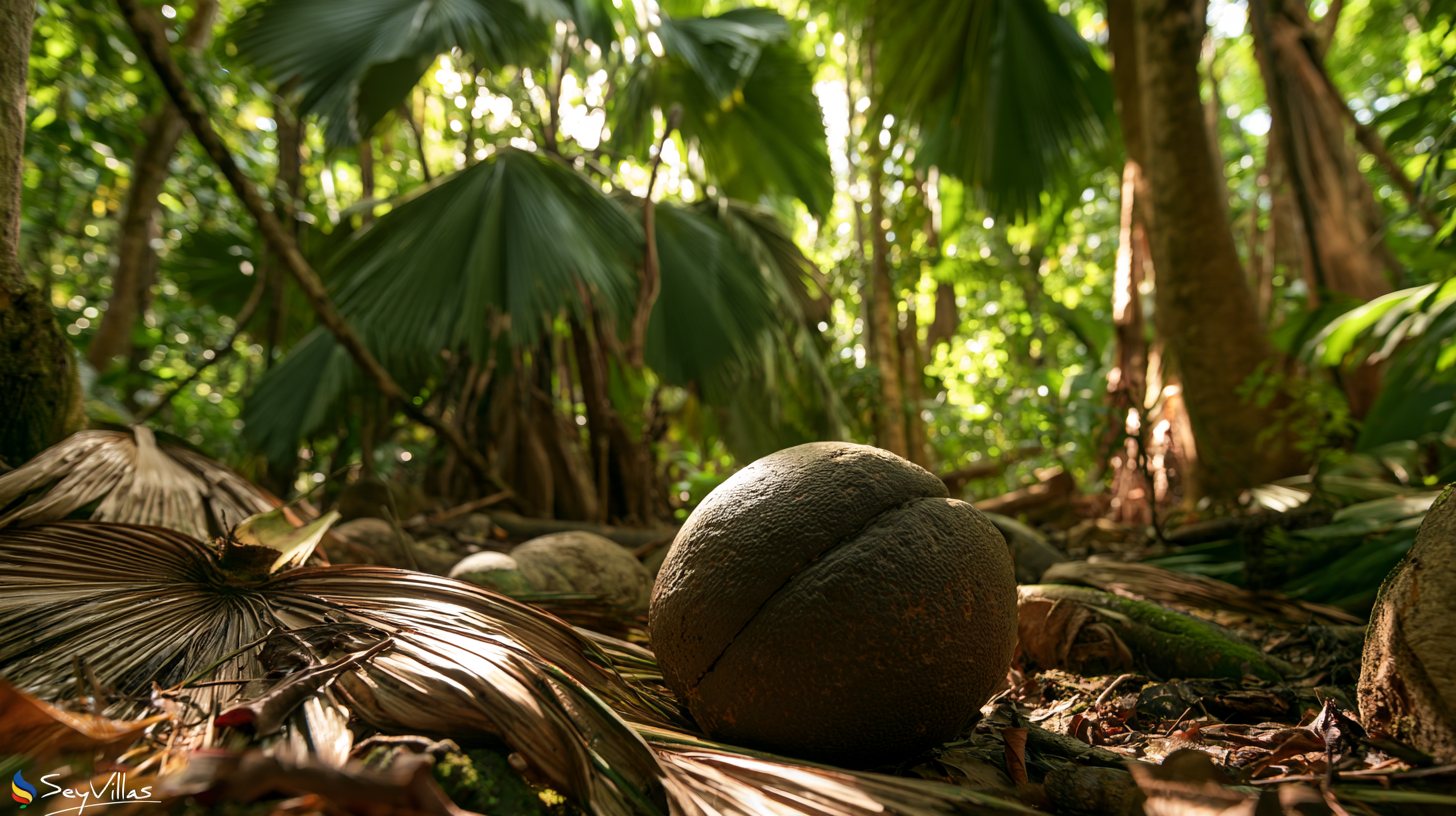
The coco de mer (Lodoicea maldivica) is a palm that grows wild only on two islands of the Seychelles, Praslin and Curieuse. It produces the largest and heaviest seed in the plant kingdom, a double-lobed nut that can weigh around 20 kg. The best place to see the palms is the Vallée de Mai on Praslin, a UNESCO World Heritage Site. Both islands make an easy day on the water from Mahé or Praslin by private yacht.
Coco de Mer at a Glance
This endemic fan palm also serves as a national symbol of the Seychelles. The key facts below cover what most visitors want to know before they go, from size records to the places where the palms grow.
- Scientific name: Lodoicea maldivica, also called the double coconut or sea coconut.
- Where it grows wild: Praslin and Curieuse only, with planted specimens on Mahé and a few other islands.
- Seed size: the largest seed of any plant, with a single nut weighing around 15 to 20 kg.
- Tree height: up to about 30 m, with fan-shaped leaves several metres across.
- Growth: a palm needs 25 years or more to start fruiting, and one nut takes six to seven years to ripen.
- Status: listed as Endangered on the IUCN Red List, with only a few thousand mature palms left in the wild.
- Where to see it: Vallée de Mai and Fond Ferdinand on Praslin, and the forest of Curieuse Island.
- By boat: Praslin and Curieuse Island sit about 15 minutes apart by sea, so one yacht day can cover both groves.
What Makes the Coco de Mer Unique
The coco de mer holds three records in the plant world: the largest wild fruit, the heaviest seed and the largest female flowers of any palm. These records come from a very slow life cycle that has no match among other palms.
The Largest Seed on Earth
A ripe coco de mer nut weighs around 15 to 20 kg, and the whole fruit with its husk can be heavier still. The nut has two rounded lobes joined at one side, which gives it its famous shape and the nickname "love nut".
The seed is so heavy that it simply drops to the ground below the parent tree. It does not float well when fresh and cannot spread on its own across the sea. This is why the palm stayed on just two neighbouring islands for thousands of years.
Male and Female Trees
Each coco de mer palm is either male or female. Male trees carry long catkins that can reach more than a metre and release pollen, while female trees grow the large green fruits.
Pollination is still studied today. Wind, insects and small lizards such as geckos are all thought to move pollen between trees in the dense palm forest.
A Very Slow Life Cycle
A fallen nut can take up to two years to germinate. It sends out a root that may travel several metres from the seed before the first leaf appears.
The young palm needs 25 years or more before it flowers for the first time. After pollination, a single fruit takes six to seven years to ripen on the tree, and a healthy palm can live for several hundred years.
Where Coco de Mer Grows
Wild coco de mer forests survive only on Praslin and Curieuse, the two granite islands in the northeast of the Inner Islands. Visitors can see the palms in three main places, each with a different kind of visit.
Vallée de Mai, Praslin
The Vallée de Mai is a protected palm forest in the centre of Praslin Island. It holds the largest natural stand of coco de mer and has been a UNESCO World Heritage Site since 1983.
Marked trails run through the forest, from a short loop of about an hour to longer walks of two to three hours. Guided walks are available at the entrance, and the forest is also home to the rare Seychelles black parrot.
Coco de mer shares the forest with the five other palm species found only in the Seychelles, including the latanier and the palmiste. Endemic geckos, skinks and tree frogs live among the leaves, and visitors often spot bright green day geckos on the palm trunks.
The reserve is managed by the Seychelles Islands Foundation. Foreign visitors pay an entry fee at the gate, and the park opens during the day only, so a morning visit gives the most time on the trails.
Curieuse Island
Curieuse lies about 1.5 km off the north coast of Praslin, inside a marine national park. Coco de mer palms grow on its hills next to the island's mangroves and its colony of giant tortoises.
There are no roads or hotels on Curieuse, and the only way to get there is by boat. Most visitors combine the palms with a walk on the coastal trail and a swim at Anse José.
Fond Ferdinand and Planted Palms
Fond Ferdinand protects a smaller area of palm forest in the south of Praslin, near Anse Marie-Louise. Guided walks there see fewer visitors than the Vallée de Mai. The upper trail opens a view over the sea toward La Digue.
Outside these two islands, the palm grows only where people have planted it. The Botanical Garden in Victoria on Mahé has mature specimens, which suits travellers who cannot reach Praslin.
Legends and History of the Coco de Mer
For centuries, nobody knew where the coco de mer came from. Old husks drifted across the Indian Ocean and washed up in the Maldives, India and Sri Lanka. The trees themselves stayed hidden on two uninhabited islands.
Sailors believed the nuts grew on a tree at the bottom of the sea, which gave the palm its French name, meaning "coconut of the sea". The species name maldivica comes from the Maldives, where most of these drifting nuts were found.
Because they were so rare, the nuts were worth a fortune in Europe and Asia. Royal collectors kept them as treasures, and some believed the flesh worked as an antidote to poison.
French explorers found the palm forests on Praslin in 1768. More than a century later, the British general Charles Gordon visited the Vallée de Mai and became convinced it was the original Garden of Eden.
Local legend adds a more romantic story. On stormy nights, it is said, the male palms walk over to the female trees, and anyone who sees them will not live to tell about it.
The palm remains a national emblem today. It appears on the Seychelles coat of arms, and the entry stamp in a visitor's passport has the shape of the nut.
Buying and Taking Home a Coco de Mer
Coco de mer nuts can be bought legally in the Seychelles, but only with official paperwork. Every legal nut carries a numbered seal and comes with an export permit issued by the authorities, and customs at the airport checks both.
The trade has been controlled since 1978 to protect the wild population. Licensed shops in Victoria and on Praslin sell certified nuts, usually as polished and hollowed shells.
Prices are high and depend on the size and finish of the nut. Many visitors choose smaller souvenirs instead, such as carved items or the decorative stamps and postcards sold near the Vallée de Mai.
The law forbids taking a nut from the forest floor. A coco de mer without a seal and permit will be confiscated, and the owner can face a fine.
Seeing Coco de Mer Palms on a Yacht Day Trip
A private yacht lets you combine both coco de mer islands in a single day. Curieuse has no ferry service, and the boat can wait while you walk the trails and then move on to the next stop.
A typical day starts on Praslin with a morning in the Vallée de Mai, reached by a short taxi ride from Baie Sainte Anne or Côte d'Or. In the afternoon, the yacht crosses to Curieuse for the palms, the tortoises and a swim.
Curieuse also has a ranger station at Baie Laraie, where visitors pay the marine park fee. The yacht can anchor in the bay or drop guests at the beach. After the trail walk, the crew can pick everyone up on the other side of the island.
From Mahé, Praslin is a longer crossing, so many guests start the day early or plan a two-day route with a night at anchor. Beaches such as Anse Lazio and St. Pierre islet fit easily between the two islands. Our guide to the best beaches in Praslin lists more stops for the same route.
Coco de Mer FAQ
Where does the coco de mer grow?
The coco de mer grows wild only on Praslin and Curieuse in the Seychelles. Planted palms can also be seen in the Botanical Garden in Victoria on Mahé.
How heavy is a coco de mer nut?
A ripe coco de mer nut usually weighs around 15 to 20 kg. No other plant on Earth produces a larger or heavier seed.
Can you buy a coco de mer in the Seychelles?
Yes, licensed shops in Victoria and on Praslin sell certified nuts. Each legal nut has a numbered seal and an export permit, which customs checks at the airport.
Why is it called coco de mer?
The name means "coconut of the sea" in French. Sailors found the nuts floating in the ocean and believed they grew on trees at the bottom of the sea.
How long does a coco de mer take to grow?
A palm needs 25 years or more before it bears fruit for the first time. Each nut then takes six to seven years to ripen on the tree.
Can you visit Curieuse Island to see coco de mer?
Yes, Curieuse has coco de mer palms on its hills and can be reached only by boat from Praslin. A private yacht lets you combine it with the Vallée de Mai in one day.
Practical Tips for Seeing Coco de Mer
Plan the Vallée de Mai for the morning, when the forest is cooler and the trails are quieter. Wear closed shoes, since the paths are uneven and can be wet after rain.
Bring cash or a card for the entry fee and a bottle of water for the walk. Inside the reserve, stay on the marked trails and do not touch fallen nuts or young palms.
The Seychelles climate allows visits all year, though the calm months of April, May, October and November make the boat crossing to Curieuse the most comfortable. For more ideas on Praslin and nearby islands, see our list of things to do in Seychelles.