Seychelles Weather in August — Trade Winds, Sea Conditions & Yacht Travel Guide
May 8, 2026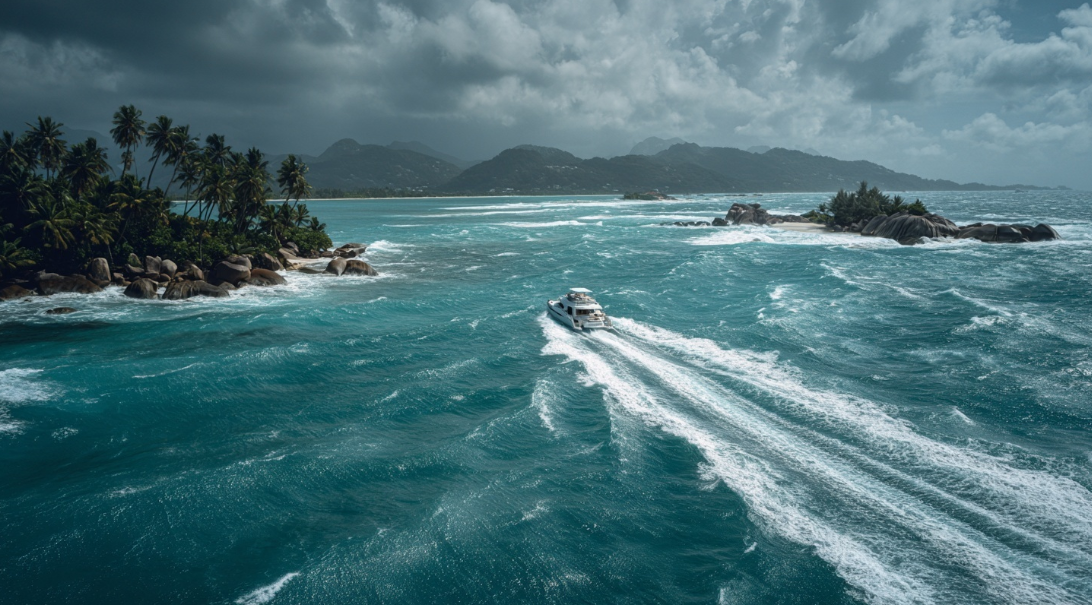
August on the Seychelles archipelago delivers daily mean temperatures around 26°C (79°F), with daytime highs reaching about 28°C and overnight lows near 24°C. Sea surface temperatures hold steady at approximately 28°C, monthly rainfall averages 97 mm across roughly 10 wet days, relative humidity sits at 79%, and the islands receive about 8 hours of sunshine per day. The dominant climatic feature of the month is the southeast trade wind, which blows at average speeds of 13 mph (20 km/h) with regular gusts of 20–25 mph. August ranks among the driest and coolest months in the Seychelles calendar, producing a pronounced split between exposed southeastern coastlines and sheltered northwestern shores.
Seychelles August Weather at a Glance
August weather in Seychelles is defined by stable temperatures, low rainfall, sustained southeast trade winds, and a clear divide in sea conditions between the windward and leeward sides of each island.
Core climate metrics for August in Seychelles:
- Average daily temperature — 26°C (79°F)
- Daytime high temperature — 28°C (82°F)
- Nighttime low temperature — 24°C (75°F)
- Sea surface temperature — 28°C (82°F)
- Monthly rainfall — 97 mm (3.8 inches)
- Average rainy days — 10
- Relative humidity — 79%
- Sunshine hours per day — 8
- Wind speed — 13 mph (20 km/h), gusts to 25 mph (40 km/h)
- Wind direction — southeast (trade winds)
- UV index — 11 (extreme)
August falls in the middle of the southeast monsoon season in Seychelles, which runs from May through September. This places the month firmly in the dry, cool half of the climatic year and gives it the most consistent daily weather pattern of any period on the archipelago.
The practical consequence of these conditions is direct. Travelers who plan around the wind direction enjoy comfortable temperatures, minimal rain, and active sea conditions ideal for sailing and water sports. Those who hope for glassy calm beaches across every coastline encounter waves, seaweed, and reduced underwater visibility on roughly half of each island's shoreline.
Temperature in Seychelles in August
Daytime air temperatures in Seychelles in August range from 26°C to 28°C, while nighttime temperatures drop to 23–24°C, yielding an average daily temperature of approximately 26°C. The temperature swing between day and night remains small — typically 4 to 5 degrees — because the surrounding Indian Ocean moderates the climate year-round.
Sea surface temperature in August holds around 28°C across all main islands. This places the water just below body temperature and removes any cold-shock barrier for swimmers, snorkelers, and divers. Sea temperature in the Seychelles never falls below 26°C in any month, making swimming feasible year-round.
August is one of the cooler months in Seychelles, alongside July and September, with mean temperatures running 2–3 degrees below the December–February peak. The combination of moderated daytime highs and steady southeast wind makes the perceived temperature noticeably more comfortable than in the windless months of November or March.
Felt temperature in August benefits from the constant breeze, which reduces the impact of 79% humidity. Visitors report comfortable conditions for walking, hiking, and outdoor dining throughout the day, with only brief uncomfortable spells during midday hours on sheltered sites away from the wind.
Rainfall and Humidity in Seychelles in August
August registers approximately 97 mm of rainfall on Seychelles spread across about 10 rainy days, making it one of the four driest months of the year alongside June, July, and September. The total precipitation runs roughly one-third of the December peak and less than half of January's average.
Rain in August typically takes the form of brief tropical showers rather than sustained downpours. Most showers last 15 to 30 minutes, often pass through during early morning or late afternoon, and rarely interrupt full-day plans. Sunshine usually returns within an hour of any rainfall event.
Relative humidity in August averages 79%, sitting near the annual mean for Seychelles. The constant southeast trade winds offset the humidity by accelerating evaporation from the skin, so most visitors describe the climate as warm but breezy rather than oppressive.
The contrast with the wet season (December through February) is significant. Wet-season months receive 250–400 mm of rainfall per month, with prolonged downpours, frequent thunderstorms, and humidity exceeding 85%. August offers conditions that are the opposite in nearly every way — short showers, dry air movement, and consistent sunshine.
Southeast Trade Winds in August
The southeast trade wind is the defining feature of August weather in Seychelles. It is a steady, dry airflow that originates over the southern Indian Ocean and sweeps northwestward across the archipelago between May and September, peaking in strength during July and August.
Average wind speed in August reaches 13 mph (20 km/h), with regular gusts of 20–25 mph (32–40 km/h). Stronger gusts of 30+ mph occur on exposed headlands and during afternoon hours when thermal effects amplify the airflow.
The wind divides every island in the Seychelles archipelago into two distinct zones. Southeastern coastlines, which face the wind directly, become the windward (exposed) side. Northwestern coastlines, sheltered by inland terrain, remain on the leeward (protected) side. This single distinction governs almost every practical decision a traveler makes in August — which beach to visit, which activity to plan, and where to anchor a yacht.
Direct consequences of the trade wind in August include four practical effects:
- Sea waves rise to 1–2 meters on windward coasts and stay below 0.5 meters on leeward coasts
- Underwater visibility drops from 25–30 meters in calm months to 5–15 meters on exposed dive sites
- Sargassum seaweed and floating seagrass accumulate on southeastern beaches
- Surface currents along the south and east coasts strengthen and can pose risks for casual swimmers
The wind benefits certain activities and constrains others. Sailing, kitesurfing, windsurfing, and ocean fishing perform at their annual peak in August. Scuba diving on windward sites, snorkeling in open water, and relaxed swimming on southeastern beaches face their tightest constraints of the year.
Sea Conditions in August
Sea conditions in August in the Seychelles split sharply by coastline orientation. Northwestern beaches remain calm with waves below half a meter, transparent water, and minimal current. Southeastern beaches show consistent wave action of 1–2 meters, reduced underwater visibility, and surface drift that can pull swimmers toward open water.
Underwater visibility drops noticeably on exposed dive sites during August. Typical visibility on the windward sides of Mahé, Praslin, and La Digue ranges from 5 to 15 meters, compared with 25 to 30 meters during calm months like April and October. Visibility on the leeward sides holds at 15 to 25 meters, which still supports productive snorkeling and diving.
Seasonal seaweed appears on windward coasts during the southeast monsoon. Floating sargassum mats and detached seagrass collect along southeastern beaches throughout August, sometimes washing ashore in thick bands. These accumulations are natural, harmless, and cleared regularly on managed resort beaches, though they affect the visual appearance of the shoreline.
Coastal currents intensify on the south and east coasts of all main islands in August. Beaches such as Anse Royale, Takamaka, and Baie Lazare on Mahé, along with Grand Anse on La Digue, develop pronounced longshore and rip currents that local authorities flag as unsafe for swimming during the southeast monsoon.
Sea temperature remains around 28°C across all coastlines, so the only difference between windward and leeward swimming lies in wave and current behavior, not water temperature.
How August Compares to Other Months in Seychelles
August occupies the middle of the southeast monsoon season and represents the most pronounced wind-driven weather of the year in Seychelles. Compared with adjacent months, August runs about the same temperature as July and September, registers slightly less rainfall than September, and produces stronger, sustained winds than either.
The table below compares August with key reference months across the Seychelles year:
|
Month |
Avg Temperature |
Rainfall |
Wind Speed |
Sea State |
Season |
|
January |
27°C |
386 mm |
10 mph (NW) |
Variable |
Peak wet |
|
April |
28°C |
178 mm |
6 mph (variable) |
Very calm |
Transition |
|
July |
26°C |
78 mm |
12 mph (SE) |
Wind-driven |
Dry, windy |
|
August |
26°C |
97 mm |
13 mph (SE) |
Wind-driven |
Dry, windy |
|
September |
26°C |
122 mm |
11 mph (SE) |
Wind-driven |
Dry, windy |
|
October |
27°C |
196 mm |
7 mph (variable) |
Calmer |
Transition |
|
December |
27°C |
281 mm |
9 mph (NW) |
Variable |
Wet, humid |
What sets August apart from other Seychelles months can be reduced to four distinct characteristics:
- Highest sustained wind speeds of the year, alongside July
- Among the lowest rainfall totals, alongside June and July
- Coolest air temperatures of any month, alongside July and September
- Most pronounced windward and leeward split in sea conditions
August falls within the European and Middle Eastern summer holiday window, making it a high-occupancy period for Seychelles resorts despite the wind. Room rates run lower than the December–January peak but higher than the May or October shoulder months.
Weather by Island in August
Climatic parameters in August are nearly identical across the inner Seychelles islands, but the impact of the southeast trade wind varies according to each island's shape, terrain, and coastline orientation.
Mahé
Mahé offers the most varied wind conditions of any island in the archipelago because of its size and central mountain range. The Morne Seychellois ridge, running down the spine of the island, effectively blocks the southeast trade winds, creating sharply different conditions on opposite coasts.
Northwestern Mahé — including Beau Vallon, Bel Ombre, Glacis, Anse Major, and Port Launay — remains protected throughout August. These beaches deliver calm water, minimal seaweed, and gentle swimming conditions despite the strong winds elsewhere.
Southeastern Mahé — including Anse Royale, Anse Forbans, Anse Bougainville, Takamaka, and Anse Intendance — faces the trade wind head-on. These beaches feature consistent surf, stronger currents, and a more rugged ocean character that suits surfing and beach walking better than swimming.
Victoria, the capital city on the northeastern coast, sits in a partially sheltered position. The city remains comfortable for sightseeing, dining, and walking tours, though its harbor is sufficiently exposed to wind to affect small-boat operations.
Praslin
Praslin shows a clear east-west wind split similar to Mahé but on a smaller scale. The granite hills along the central ridge provide moderate shelter to the western and northwestern coasts while leaving the eastern shore directly exposed.
Western Praslin — including Anse Lazio, Anse Georgette, Anse Kerlan, and Anse Boudin — remains the leeward side throughout August. These beaches retain their flat, transparent water and pose no swimming concerns during the southeast monsoon.
Eastern Praslin — including Anse Volbert (Côte d'Or), Anse La Blague, and Grand Anse — sits on the windward side. Anse Volbert in particular receives consistent wave action and seasonal seaweed throughout August, though it remains active for kitesurfing and shoreline activities.
La Digue
La Digue is the most exposed of the three main islands in August because of its compact size and orientation. Its small landmass offers little wind blocking, so most of the island feels the trade wind directly.
Grand Anse, Petite Anse, and Anse Cocos on the southeastern side of La Digue receive the full force of the southeast wind. These beaches show strong waves, dangerous currents, and lifeguard warnings against swimming throughout August.
Anse Source d'Argent and Anse Patates on the western and northern sides offer the only fully protected swimming on La Digue during August. These coves remain shallow, calm, and clear, sheltered by granite formations and the island's own bulk.
Outer Islands
The outer Seychelles islands — including Alphonse, Desroches, Bird Island, Denis Island, and the Aldabra group — sit far enough from the inner archipelago to show slightly different microclimates. Most of these islands remain accessible only by private charter or scheduled small-plane flights.
Alphonse and Desroches serve as exclusive fly-fishing and diving destinations in August because their isolated locations preserve clearer waters and stable tropical conditions. The southeast wind affects them similarly to the inner islands, but with less coastal infrastructure to mitigate the effects of seaweed and currents.
Aldabra Atoll, located in the far southwest of the archipelago, experiences stronger and steadier trade winds than the inner islands but compensates with exceptional marine life visibility on its protected lagoon sides. Aldabra is accessible only by liveaboard expedition.
Yacht Cruises in Seychelles in August
August weather creates favorable conditions for yacht cruises along the leeward routes of the inner Seychelles islands. Stable air temperatures around 26°C, dry sunny days, low humidity, and a steady breeze on deck produce some of the most comfortable on-water hours of the year, provided the route avoids exposed windward stretches.
Morning departures deliver the calmest sea state of the day in Seychelles in August. Trade wind speeds typically run 8–10 mph in the early morning, climb to 13–15 mph by midday, and peak at 15–20 mph during the late afternoon. Cruises that depart between 8 AM and 10 AM benefit from the smoothest passage on outbound legs.
Swim and snorkel stops during August yacht cruises work best at the leeward anchorages. Protected sites such as Anse Major, Port Launay, Sainte Anne Marine Park, Curieuse Island, and Cocos Island offer clear water, calm surface conditions, and visibility of 15–25 meters. These stops remain feasible throughout the month, regardless of how strong the wind blows outside the bay.
Sunset cruises run reliably in August because trade wind speeds drop in the final hour before sunset. The wind typically eases from 13 mph to 6–8 mph between 5 PM and 7 PM, the sky clears after any brief afternoon shower, and the temperature settles in the comfortable 25–26°C range for evening passages along the western Mahé coast.
On-deck comfort in August benefits from the constant breeze, which neutralizes the humidity and keeps deck temperatures lower than those in air-conditioned indoor spaces after a short stay outside. Bimini tops and sun awnings provide shade during peak UV hours, and the absence of rain on most days allows continuous outdoor seating.
Brief tropical showers occasionally pass through during August yacht cruises. Showers typically last 10–20 minutes, do not disrupt the cruise, and clear quickly. Captains adjust the route to keep showers astern when possible, and most modern charter yachts include enclosed indoor seating for the short duration of any rain.
BBQ service on board operates normally in August. The steady breeze improves grill performance compared to windless months, and the dry air keeps deck dining comfortable. Most yacht charters from Eden Island Marina, including CharterClick options, have onboard BBQ stations as part of the standard package.
Family yacht cruises in August suit groups with children when routes focus on protected anchorages. The Sainte Anne Marine Park circuit from Eden Island Marina, the Cocos Island day route from La Digue, and the Anse Lazio anchorage from Praslin all keep families in sheltered waters with safe swimming throughout the cruise.
Party and celebration cruises operate throughout August across the inner archipelago. Birthday charters, wedding parties, and corporate group cruises run on the same protected routes used by family trips, with sunset return legs that take advantage of the calmer evening wind.
Yacht Charters and Sailing in Seychelles in August
August ranks among the most reliable months of the year for yacht sailing in Seychelles. The steady southeast trade winds provide predictable propulsion, the dry weather minimizes interruptions, and the temperatures remain comfortable for full-day passages.
Sailing routes that work well in August follow the leeward sides of the inner islands. The standard inner-archipelago itinerary — Mahé to Praslin to La Digue and back — uses the wind for downwind legs and threads through sheltered channels between islands.
Protected anchorages favored during August include several known sites across the inner archipelago:
- Sainte Anne Marine National Park near Victoria — sheltered by surrounding islands, calm overnight conditions
- Curieuse Island — protected northern bay, snorkeling access to the marine reserve
- Cocos Island near La Digue — a small uninhabited anchorage with clear surrounding water
- Sister Islands near La Digue — leeward stops with strong visibility
- Anse Lazio on Praslin — daytime anchorage at the world-class beach
Routes that face challenges in August include the eastern approaches to Praslin and La Digue, open-water transfers to outer islands during peak wind hours, and any planned anchoring on windward coasts. Experienced captains adjust departure times to morning hours when wind speeds typically run lower.
Eden Island Marina in Victoria, Mahé, serves as the main yacht-charter base in the Seychelles. The marina provides protected mooring throughout the southeast monsoon, customs clearance for inter-island travel, and access to provisioning, fuel, and crew services. Most charters depart Eden Island in the morning and reach Praslin in 3–4 hours under typical August conditions.
CharterClick operates yacht rentals from Eden Island Marina across a fleet that includes day cruisers, overnight cruisers, and motor yachts suited to August wind conditions. The platform handles route planning, captain assignment, and provisioning, allowing travelers to focus on the destination rather than the logistics of monsoon-season sailing.
Half-day, full-day, and multi-day charters all run reliably in August. Half-day charters typically cover the protected route from Eden Island to Sainte Anne Marine Park and back. Full-day charters extend to Round Island, Long Island, or the protected anchorages along Mahé's western coast. Multi-day charters work the standard Mahé–Praslin–La Digue triangle with overnight stops at sheltered bays.
Is August a Good Time to Visit Seychelles
August is a good time to visit Seychelles for travelers willing to adapt their plans to the wind direction and choose beaches and activities accordingly. It is not the right choice for visitors expecting calm water across every coastline or maximum underwater visibility on all dive sites.
The recommendation breaks down by traveler type:
- Couples seeking calm beaches — recommended, provided they base on the northwestern coasts of Mahé or Praslin
- Families with young children — recommended, with stays focused on protected lagoons such as Port Launay, Anse Lazio, or Anse Source d'Argent
- Honeymooners — recommended, particularly at resorts on western Mahé and northwestern Praslin
- Surfers and kitesurfers — strongly recommended, August delivers the strongest wind and most consistent swell of the year
- Sailors and yacht charterers — strongly recommended, ideal conditions for the inner-island triangle
- Anglers and deep-sea fishers — strongly recommended, peak migration season for tuna, wahoo, and sailfish
- Scuba divers — suitable with caveats, leeward sites work well, but visibility on exposed reefs drops
- Snorkelers — suitable with caveats, protected coves offer good conditions, but open-water snorkeling is reduced
- Bird watchers and naturalists — strongly recommended, peak nesting season at Bird Island, Aride, and Cousin
- Hikers and trail walkers — strongly recommended, cool air and dry paths
- Travelers wanting glass-flat water on every coastline — better to choose April, October, or November
European, Middle Eastern, and Indian visitors make up the bulk of August arrivals because the month overlaps with summer holidays in those regions. Resort occupancy runs high, and advance booking is recommended for inter-island ferries, popular restaurants, and yacht charters.