Seychelles vs Fiji — Islands, Beaches, Yacht Charters & Travel Comparison
May 18, 2026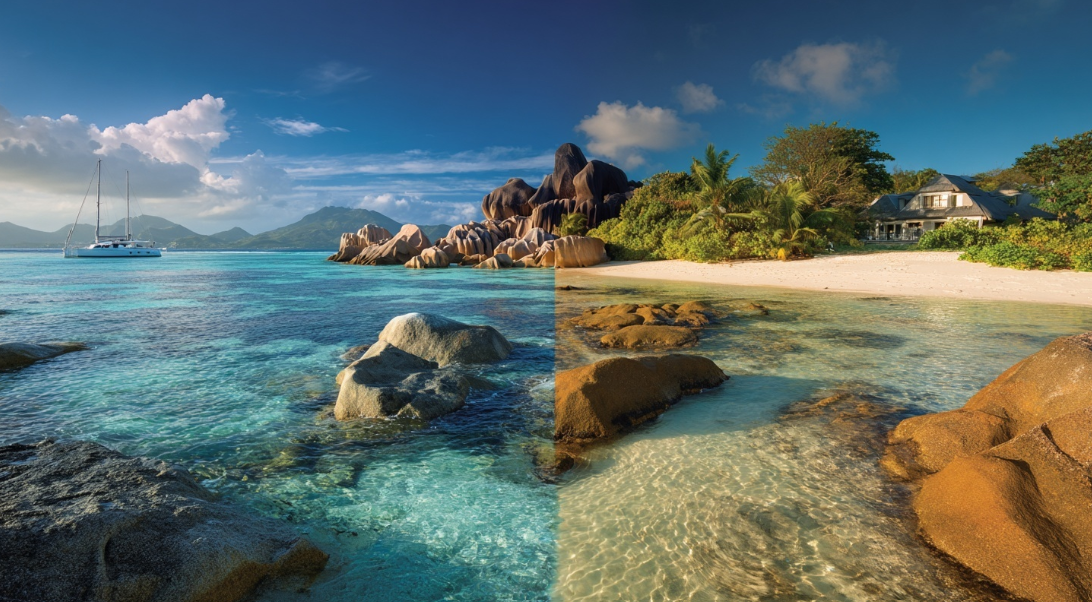
Seychelles is a 115-island archipelago in the western Indian Ocean, located roughly 1,500 km east of Kenya. Fiji is a country of 333 islands in the southern Pacific Ocean, located approximately 3,000 km east of Australia. Both qualify as classic tropical island destinations, but they differ in geographic scale, ocean basin, climate cycle, and how travelers move between the islands.
Seychelles works best for short-haul trips from Europe, the Middle East, and East Africa. Fiji works best for travelers based in Australia, New Zealand, North America, and East Asia. The choice between the two typically depends on flight access, the type of landscape preferred, and whether the trip involves a single resort base or multi-island travel.
Seychelles vs Fiji at a Glance
The table below compares Seychelles and Fiji across the criteria most relevant to travel planning.
|
Criterion |
Seychelles |
Fiji |
|
Location |
Western Indian Ocean |
South Pacific Ocean |
|
Distance from main hub |
~1,500 km east of Kenya |
~3,000 km east of Australia |
|
Number of islands |
115 |
333 |
|
Inhabited islands |
~8 main |
~110 |
|
Total land area |
455 km² |
18,274 km² |
|
Capital |
Victoria (Mahé) |
Suva (Viti Levu) |
|
Main international airport |
Seychelles International (SEZ), Mahé |
Nadi International (NAN), Viti Levu |
|
Currency |
Seychellois rupee (SCR) |
Fijian dollar (FJD) |
|
Official languages |
English, French, Seychellois Creole |
English, Fijian, Fiji Hindi |
|
Visa for most western passports |
Tourist Authorisation, online application |
Visa-free entry, up to 4 months |
|
Best months to visit |
April–May, September–October |
May–October |
|
Water temperature |
26–29°C year-round |
25–29°C year-round |
|
Inter-island transit |
Domestic flights, Cat Cocos ferry, yacht charter, helicopter |
Domestic flights, ferries, Yasawa Flyer, seaplane, yacht charter |
|
Dominant landscape |
Granite islands, white sand, coral fringing reefs |
Volcanic islands, coral atolls, lagoons behind barrier reefs |
Island-Hopping and Inter-Island Travel
Both destinations require inter-island movement for a full trip, but the geometry of each archipelago and the available transit options are structurally different.
Inter-Island Travel in Seychelles
Seychelles is one of the most compact tropical archipelagos in the world. The three main inhabited islands — Mahé, Praslin, and La Digue — sit within 50 km of each other. The crossing from Mahé to Praslin is 44 km (about 24 nautical miles). Praslin to La Digue is just 7 km (4 nautical miles).
Inter-island options in Seychelles cover four main modes. Cat Cocos operates a daily catamaran ferry covering Mahé–Praslin in approximately 1 hour and Praslin–La Digue in 15 minutes. Air Seychelles runs domestic flights between Mahé and Praslin in 15 minutes. Helicopter transfers via Zil Air and Helicopter Seychelles connect the main islands and outer resorts. Private yacht charter combines transit with accommodation across the inner-island circuit.
Inter-Island Travel in Fiji
Fiji spreads across a much larger ocean area. Viti Levu to Vanua Levu is roughly 65 km at the narrowest crossing. Reaching the outer Yasawa group from Nadi takes 4–5 hours by ferry. Reaching Taveuni from Nadi requires a domestic flight of 1 hour 15 minutes.
Inter-island options in Fiji cover five main modes. Fiji Airways and Fiji Link operate domestic flights from Nadi to Taveuni, Savusavu, Kadavu, and Labasa. South Sea Cruises runs day passes and resort transfers around the Mamanuca group. Awesome Adventures Fiji operates the Yasawa Flyer catamaran serving the Yasawa chain. Seaplane and helicopter transfers connect Nadi to luxury island resorts. Yacht and catamaran charter covers multi-day cruises.
Yacht Charter as a Transit Mode
Yacht charter functions as a transit and accommodation mode in both destinations, but in different formats. Seychelles favors short charters of 4–7 nights with daily passages of 2–3 hours between calm anchorages. Typical itineraries cover Mahé → Praslin → La Digue → Curieuse → Sainte Anne, with optional outer-island extensions to Bird, Denis, or Aride. Fiji charters typically run 7–14 nights with longer ocean passages and an exploratory format covering Mamanuca and Yasawa, or a dive-focused route through Bligh Water to Vanua Levu and Taveuni.
CharterClick is a yacht charter platform operating from Eden Island Marina on Mahé, providing a fleet for short-passage Seychelles itineraries between the inner islands. The compact geography of the inner archipelago allows charter routes to fit within 4–7 nights without long open-ocean legs, which keeps the format accessible for first-time charter guests and family groups.
The structural difference for trip planning is the following. In Seychelles, a yacht charter functions as a "moving hotel" across short distances, with most travel time spent at anchor or in shallow lagoons. In Fiji, a yacht charter functions as an expedition cruise with significant time underway and stronger demand on sailing experience or full crew support.
Climate and Best Time to Visit
Climate Patterns and Water Temperature
Seychelles has an equatorial maritime climate with two monsoon seasons and no real cyclone risk. The southeast monsoon runs May to September, bringing cooler temperatures (24–29°C), lower humidity, and steadier breezes. The northwest monsoon runs December to March, bringing warmer temperatures (26–32°C), higher humidity, and intermittent heavy rain.
Fiji has a tropical maritime climate with a clearer wet-and-dry split and an active cyclone season. The dry season runs May to October with temperatures of 20–29°C, lower humidity, and dependable sunshine. The wet season runs November to April with temperatures of 22–32°C, higher rainfall, and cyclone risk peaking January to March.
Water temperature in Seychelles stays between 26°C and 29°C across the year, with the warmest months from March to May. Water temperature in Fiji ranges from 25°C in August to 29°C in February.
Best Time to Visit Each Destination
April and October are transitional months in Seychelles, typically calm with low wind and good underwater visibility. These months are widely considered the optimal windows for snorkeling, diving, and sailing. May to September is the second strong window, with cooler air and steady trade winds favorable for sailing but with slightly choppier sea conditions.
May to October is the prime window in Fiji. Skies are predominantly clear, humidity drops, and sea conditions stabilize. July to September are the most reliable months for diving, surfing, and snorkeling. November to April is best avoided due to tropical storm risk, although February and March can deliver excellent diving conditions at sheltered reefs in non-cyclone years.
Month-by-Month Comparison
A month-by-month recommendation between the two follows this pattern. January to March favors Seychelles, since Fiji is in peak cyclone risk. April favors Seychelles for its calm transitional window. May to October works for both, with Fiji generally drier. November and December favor Seychelles, since Fiji enters its wet season.
Landscape and Beaches
Beach Geology and Character
Seychelles beaches are defined by granite formations and very fine white sand. The inner granitic islands — Mahé, Praslin, La Digue, and surrounding satellites — feature granite boulders polished by sea and wind, narrow crescent bays, shallow turquoise lagoons, and takamaka and coco-plum trees lining the shore. The outer coral islands (Aldabra, Bird, Denis) feature flatter coral terrain and broader beaches.
Fiji beaches are defined by volcanic and coral geology. Viti Levu and Vanua Levu have black-sand stretches alongside white-sand bays, mangrove edges, and reef-protected lagoons. The Yasawa and Mamanuca groups offer long crescent beaches with palm-fringed margins, gradual sandy slopes, and barrier reefs visible offshore.
Iconic Beaches
Iconic beaches in Seychelles include Anse Source d'Argent on La Digue, frequently cited among the most photographed beaches in the world thanks to its granite formations; Anse Lazio on Praslin, recognized for its broad sweep and clear water; and Anse Georgette on Praslin, accessible only via Constance Lemuria resort or by boat.
Iconic beaches in Fiji include Natadola Beach on Viti Levu, known for its long sandy stretch and surf break; the beaches of the Mamanuca group, used as the filming location for Cast Away (Monuriki); and the secluded bays of the northern Yasawa chain (Nanuya Lailai, Sawa-i-Lau).
Beach Access Rules
Beach access patterns differ. Most beaches in Seychelles are publicly accessible, including those fronting major resorts, due to a law guaranteeing public foreshore use. In Fiji, many of the most photographed beaches sit within private resort grounds in the Yasawa and Mamanuca chains, with limited access for non-guests.
For travelers prioritizing visual landscape uniqueness, Seychelles holds the edge thanks to its granite formations, which do not appear in any other major tropical destination. For travelers prioritizing extended sandy beaches and reef-protected lagoons, Fiji offers more variety in beach type and a wider range of resort settings.
Snorkeling, Diving, and Water Sports
Seychelles offers coral gardens surrounding granitic islands with short boat transfers between snorkeling sites and good year-round visibility. Fiji ranks among the world's leading destinations for soft coral diving and reef variety, with larger marine areas and stronger currents producing high biodiversity.
Top Snorkeling and Dive Sites in Seychelles
Top snorkeling sites in Seychelles include Sainte Anne Marine National Park (boat trip from Mahé, accessible all year), Curieuse and Saint Pierre near Praslin (giant tortoise habitat plus coral gardens), and Aride Island. Cousin Island Special Reserve provides bird and turtle nesting habitat alongside reef snorkeling.
Top dive sites in Seychelles include Shark Bank, Brissare Rocks, Ennerdale Wreck, and the Aldabra atoll (for experienced divers, reached only via liveaboard or specialist expedition). Whale shark sightings peak between August and October, particularly off the western coast of Mahé.
Top Snorkeling and Dive Sites in Fiji
Top snorkeling and dive sites in Fiji include Rainbow Reef in the Somosomo Strait (between Vanua Levu and Taveuni), Beqa Lagoon (known for its shark dives), the Great Astrolabe Reef off Kadavu (one of the largest barrier reefs in the world), and Namena Marine Reserve. Manta ray season in the Yasawa group runs May to October.
Surfing
Fiji is a recognized world-class surfing destination. Cloudbreak, Restaurants, and Frigate Pass off the southern Mamanuca group attract advanced surfers seeking reef breaks. Seychelles does not offer comparable reef-break surfing.
Day Cruises and Other Water Sports
Day yacht trips are popular in both destinations as half-day or sunset experiences, typically combining a short cruise with snorkeling stops, on-board catering, and swimming. In Seychelles, common day-cruise routes run from Eden Island Marina around Sainte Anne or to Round Island and Île au Cerf. In Fiji, day cruises run from Port Denarau or Vuda Marina to nearby Mamanuca islands.
Other water sports — kayaking, paddleboarding, jet-skiing, parasailing, kitesurfing — are available at all major resorts in both destinations. Kitesurfing conditions are reliable in Seychelles from May to September on the windward coasts of Mahé and Praslin. Fiji's kitesurfing scene centers on Nananu-i-Ra and the Coral Coast.
Activities and Things to Do
Activities in Seychelles center on natural reserves, endemic wildlife, short hikes, and beach-based leisure. Activities in Fiji span a wider range, including cultural village visits, longer hikes, adventure sports, and a more developed nightlife scene.
Wildlife and Nature Reserves
Wildlife in Seychelles includes Aldabra giant tortoises (most accessible at Curieuse Island), the coco de mer palm (found only in the Vallée de Mai on Praslin, a UNESCO World Heritage Site), and endemic birds such as the Seychelles black parrot, Seychelles magpie-robin, and Seychelles paradise flycatcher (on Denis and La Digue).
Wildlife in Fiji includes humpback whales (passing July to October in southern waters), reef sharks (especially in Beqa Lagoon), and tropical birds across Taveuni and Kadavu. Bouma National Heritage Park on Taveuni contains rainforest waterfalls and the Lavena Coastal Walk.
Hiking and National Parks
Hiking in Seychelles is concentrated in Morne Seychellois National Park on Mahé, with trails reaching 905 meters at the summit of Morne Seychellois. Praslin offers shorter trails through the Vallée de Mai and Glacis Noire National Park. Hike durations typically range from 2 to 5 hours.
Hiking in Fiji includes Mount Tomanivi (1,324 meters) on Viti Levu and the Lavena Coastal Walk on Taveuni. The Sigatoka Sand Dunes National Park offers a coastal archaeological hike.
Culture and Cuisine
Cultural offerings differ in character. Seychelles culture reflects a Creole mix of French, African, Indian, and British heritage, with Creole food (curries, octopus, breadfruit, lentil dishes) as a central element. Fiji culture combines indigenous Fijian and Indo-Fijian heritage (descendants of indentured laborers from India), expressed in kava ceremonies, traditional lovo earth-oven feasts, meke dance performances, and Indian curries.
Nightlife and Family Programs
Nightlife is low-key in both destinations. Fiji's Denarau Island and Coral Coast offer more concentrated bars, clubs, and resort entertainment. Seychelles has almost no organized nightlife outside resort bars on Mahé.
Family activities are stronger in Fiji thanks to a denser cluster of family-oriented resorts (Outrigger, Sheraton, Sofitel, Shangri-La) with structured kids clubs, shallow lagoons, and adventure programs. Seychelles has family-friendly resorts but fewer dedicated family programs at scale.
Entry Requirements, Currency, and Language
Both destinations offer visa-free or simplified entry for most western, GCC, and Commonwealth passports. The exact mechanics and validity differ.
Visa and Entry Rules
Seychelles requires a Tourist Authorisation, applied for online before travel. The authorisation is mandatory for all visitors regardless of nationality. Standard requirements include a valid passport, proof of return ticket, confirmed accommodation, and travel health insurance. The authorisation is typically issued within 1–3 days. Initial stay is up to 3 months and is extendable.
Fiji grants visa-free entry to citizens of more than 100 countries, including the US, UK, EU member states, Canada, Australia, New Zealand, the UAE, and most Commonwealth nations. The initial visitor permit covers stays of up to 4 months. A return ticket and sufficient funds are required at entry.
Currency and Payments
The Seychellois rupee (SCR) is the local currency in Seychelles. Resort transactions are commonly quoted in euros or US dollars, but local restaurants, shops, and ferry tickets use SCR. ATMs are available on Mahé, Praslin, and La Digue. Major credit cards are widely accepted.
The Fijian dollar (FJD) is the local currency in Fiji. Most resort transactions process in FJD, with USD and AUD also accepted in tourist hubs. ATMs are available on Viti Levu, Vanua Levu, and at major airports. Major credit cards are widely accepted in hotels and larger shops but less so in rural areas.
Language and Time Zones
English is an official language and the primary language of business and tourism in both countries. Seychellois Creole and French are the two other official languages in Seychelles. Fijian and Fiji Hindi are the other official languages in Fiji. Travelers can navigate both destinations in English without difficulty.
Time zones differ significantly. Seychelles operates on UTC+4, which aligns with Gulf time. Fiji operates on UTC+12, which aligns with New Zealand. The 8-hour gap affects jet-lag patterns depending on the region of departure.
Which Destination Suits Which Traveler
The choice between Seychelles and Fiji depends on the region of departure, the type of trip, and the preferred mix of landscape and activity. The categories below cover the most common decision profiles.
Honeymoon Couples and Families
Honeymoon couples seeking visual landscape uniqueness, privacy, and ultra-luxury private-island settings typically choose Seychelles. Couples seeking a wider range of resort experiences and more activity variety typically choose Fiji.
Families with children typically find Fiji more accommodating thanks to a denser concentration of family resorts with structured kids clubs and broader activity programs. Seychelles works well for families who prioritize beach and nature time over organized entertainment.
Divers, Surfers, and Backpackers
Divers and snorkelers comparing the two will find Fiji stronger overall on coral biodiversity, soft coral diversity, and shark and manta encounters. Seychelles offers easier-access reef sites with short boat transfers and seasonal whale shark sightings between August and October.
Surfers should choose Fiji. Cloudbreak, Restaurants, and Frigate Pass provide world-class reef breaks. Seychelles does not offer comparable surf.
Backpackers should choose Fiji. The Yasawa backpacker circuit, hostel network, and bungalow scene have no equivalent in Seychelles.
Luxury and First-Time Travelers
Luxury travelers can choose either destination. Seychelles emphasizes privacy on isolated granitic islands with minimal staff visibility (Six Senses, North Island, Fregate). Fiji emphasizes service depth, cultural immersion, and broader resort facilities (Laucala, Kokomo, Vatuvara).
First-time tropical travelers from Europe, the Middle East, or East Africa typically find Seychelles easier in terms of flight time, language (French and English availability), and trip planning. First-time tropical travelers from Australia, New Zealand, or North America typically find Fiji easier on the same basis.
Sailors and Yacht Charter Guests
Sailors and yacht charter guests choose Seychelles for short charters of 4–7 nights with compact inter-island passages, suitable for first-time charter trips and crewed family sailing. Fiji suits experienced charterers planning longer liveaboard cruises of 7–14 nights with bigger ocean passages and dive-focused itineraries.
Choose Seychelles if any of the following apply
- You are flying from Europe, the Middle East, or East Africa and want the shortest tropical trip
- You prioritize visually distinctive granite-and-sand landscapes over wider activity variety
- You want a short yacht charter with compact passages between inner islands
- You are planning a high-end honeymoon focused on privacy and seclusion
- You want to combine beaches with the Vallée de Mai, giant tortoises, and seasonal whale sharks
Choose Fiji if any of the following apply
- You are flying from Australia, New Zealand, or North America and want the shortest tropical trip
- You prioritize a wider range of resort experiences and activity choices
- You want a longer liveaboard yacht charter with offshore passages and dive-focused cruising
- You travel with children and want structured family programs
- You surf, or you want world-class soft coral diving in Rainbow Reef or the Great Astrolabe Reef